Black History Month is a time to honor the legacy of Black leadership and resilience, while also confronting the economic realities Black workers face today and the future we are collectively building. It calls us to look beyond history and examine how current systems continue to shape who benefits from work, who builds wealth, and who is left out.
The racial wealth gap in the United States is widely understood as the result of systemic racism that has consistently denied Black Americans access to assets, ownership and economic security. While the causes are well known, the solutions too often stop short of addressing how to move Black workers from income to equity.
Employee ownership (EO) provides a tangible pathway that ties everyday work to asset-building and expands access to ownership for Black workers who have historically been excluded. Recent research and new data tools help turn that pathway into a roadmap, illuminating how and where EO can be used to address racial income and wealth disparities.
What the research shows about ownership & wealth
New research conducted by Project Equity in partnership with Morehouse College and the University of California, Riverside provides one of the most comprehensive looks to date at how EO can function as a strategy for closing the racial wealth gap. The report, “Black Employee Ownership: A Pathway to Wealth Building and Economic Opportunity,” draws on longitudinal data, interviews, policy audits, and case studies, to explore not only whether EO improves outcomes for workers, but who benefits and under what conditions. It also looks at the policy and ecosystem support required to ensure Black communities can fully share in its benefits.
The findings reinforce a growing body of evidence showing that ownership changes economic outcomes for workers. The research builds on a growing body of evidence showing that employee owners earn higher median wages, experience lower layoff rates during economic downturns and accumulate significantly more wealth over time than their non-owner counterparts.
At the same time, the research highlights a critical gap: Black workers remain significantly underrepresented in EO, even in industries where they make up a substantial share of the workforce. This exclusion limits access to one of the most effective mechanisms for building assets through work and mirrors broader patterns of racial wealth inequality across the economy.
The findings point to a clear conclusion: EO has real potential to reduce racial wealth disparities, but only when it is intentionally designed to include Black workers and address the barriers that have historically kept ownership out of reach.
Making inequality visible: the Ownership Opportunity Map
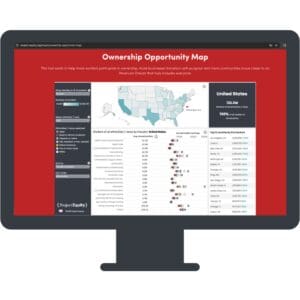 Understanding where and how inequity shows up is a critical first step toward addressing it. That is why we have developed the Ownership Opportunity Map.
The Ownership Opportunity Map is an interactive data tool that allows users to explore income disparities by race across counties, industries and regions. By visualizing wage gaps at the local and sector level, the Ownership Opportunity Map reveals patterns that are often hidden in national averages.
In many regions, Black workers are concentrated in industries with lower wages and fewer ownership opportunities. In others, they work alongside white peers in the same industries but earn significantly less. These insights matter because they can help policymakers, advocates and business leaders identify where EO could have the greatest impact.
When we can see inequity clearly, we can respond to it strategically.
What EO looks like in practice
Data can show us where inequities exist, but the case studies in this research show what it actually takes to turn EO into a wealth-building reality for Black workers and entrepreneurs. Across food distribution, recycling, retail, and business services, the examples in this report illustrate both the promise of EO and the conditions required for it to succeed.
In New York City, Brooklyn Packers, a 100% Black-owned and worker-operated food packing and distribution cooperative, demonstrates what’s possible when shared ownership is paired with public investment. Launched with just a $3,000 start-up loan and free technical assistance made possible through New York City’s Worker Cooperative Business Development Initiative, the business has grown into a $1.7 million enterprise supporting local farmers and building community wealth. Their story also shows how access to technical assistance, peer networks and aligned procurement policies can make EO viable even in a high-cost, competitive market.
By contrast, RCO Tires in Los Angeles reveals what happens when those supports are missing. Founded with a clear commitment to democratic management and shared ownership, the business achieved nearly $2 million in annual revenue, employed 22 formerly incarcerated workers and diverted massive amounts of waste from landfills. Years of denied loans, lack of accessible capital and rising commercial rents ultimately forced the business to close before EO could become a wealth-building opportunity. The lesson is not that EO failed but that without aligned capital, land access and policy infrastructure, even mission-driven, high-impact businesses can be pushed out.
Other examples sit somewhere in between. In Baltimore, Taharka Brothers, a worker-owned ice cream company, has distributed more than $90,000 in profits to workers since 2019 and continues to provide quality jobs for predominantly young Black men. Despite these successes, the business still faces challenges accessing growth capital, securing long-term affordable space, and recruiting new worker-owners—constraints that limit the scale of wealth-building EO can deliver without broader system-level support.
And, Uptima Entrepreneur Cooperative shows how EO can reshape not just individual workplaces, but entire entrepreneurial ecosystems. As a majority-Black-owned, worker-run business support organization, Uptima offers culturally relevant training while modeling shared ownership itself. Despite its success, Uptima has faced ongoing challenges accessing growth capital for itself and its clients. Its experience also underscores how deeply financial uncertainty and underinvestment limit who can realistically pursue cooperative ownership without targeted policy interventions.
Study after study has shown EO can preserve good jobs, create meaningful ownership stakes and support long-term economic mobility. What these cases highlight is that the success of EO for many Black workers hinges on intentional policy, accessible capital, technical assistance, and peer networks.
Designing ownership that delivers
EO is not a silver bullet, but it is a powerful tool when it is designed with equity at the center. Ownership outcomes are shaped by choices: who is invited into the process, how shares are allocated, how financing is structured, and whether workers receive the education and support needed to participate fully as owners. Without intention, EO can mirror existing inequities. With intention, it can help dismantle them.
That is why this latest research combined with the Ownership Opportunity Map matter. Together, they can move the conversation beyond aspiration and toward action.
From insight to action: your next steps
BUSINESS OWNERS
Secure your legacy and your bottom line. Don’t leave your succession to chance. Use our data to see how transitioning to employee ownership can stabilize your workforce and strengthen your company’s future performance.
Explore succession pathways »
ADVISORS
Become a strategic partner in resilience. Move beyond traditional exit planning. Leverage this research to offer your clients a proven model for business growth, improved retention, and long-term economic stability.
Become a certified EO advisor »
ADVOCATES & POLICYMAKERS
Drive data-backed economic development. Stop guessing where impact is needed most. Use the Ownership Opportunity Map to identify wage gaps in your region and target resources toward the industries with the highest potential for community wealth building.
Access the Ownership Opportunity Map »