Pathways to prosperity for Black workers
- Tyler Rivera
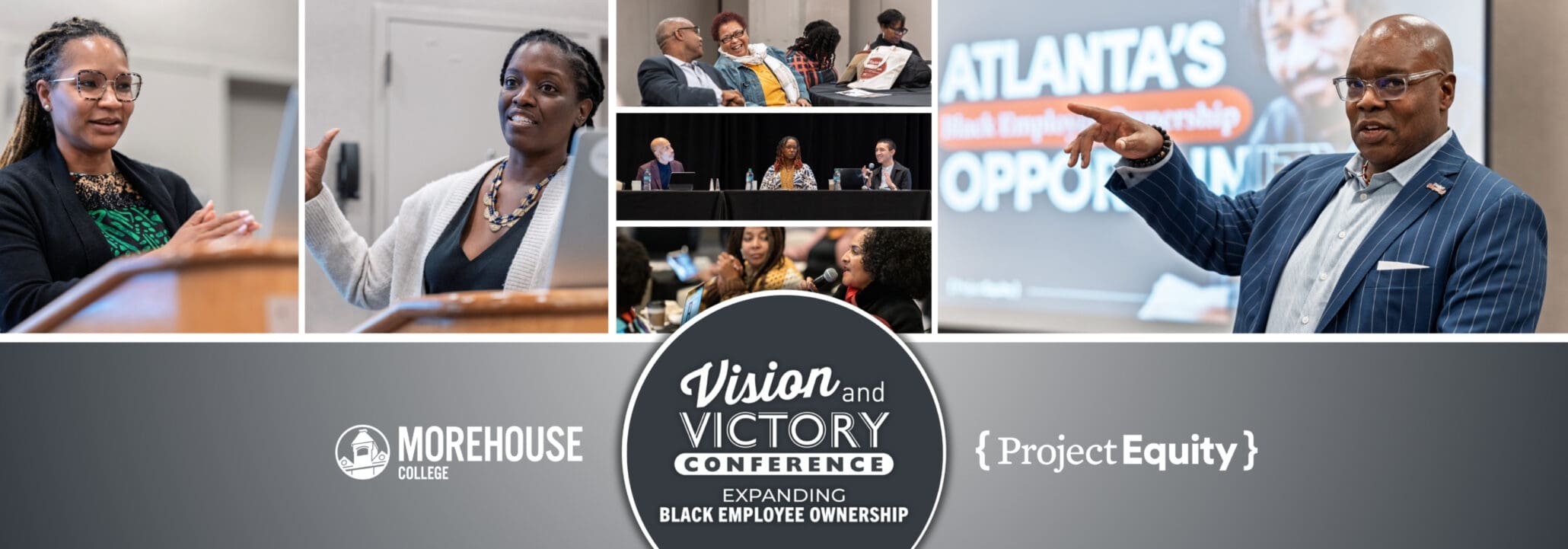
Last month, stakeholders from across the employee ownership (EO) field gathered in Atlanta for the very first Vision & Victory: Expanding Black Employee Ownership conference.
Hosted by Morehouse College’s International Comparative Labor Studies (ICLS) program, the event brought together advocates, researchers, funders, service providers, employee-owners, and community partners with varying levels of experience in EO, but a shared excitement about its potential to shape the future of Black wealth building.
Conversations throughout the three-day convening were energizing, timely, and dynamic in their connections to EO. Employee-owners shared powerful stories about finding dignity and leadership opportunities through employee-owned models.
Practitioner and policy panels explored wide-ranging topics, from a discussion of philanthropy’s role in resourcing Black EO initiatives to a session centering the voices of Morehouse graduates now working in the EO space. Academic partners helped ground the discussions with data, context, and history.
Black EO research unveiled
For our team at Project Equity, the Vision & Victory conference marked a particularly meaningful milestone: It offered the first public forum to present findings and insights from our multi-year body of research conducted in partnership with scholars at Morehouse College and the University of California, Riverside.
Through the Increasing Black Income and Wealth Through Employee Ownership project, our three institutions came together in a first-of-its-kind effort focused specifically on Black workers and Black-owned businesses and how employee ownership could serve as a lever for economic mobility and wealth-building.
Drawing on the distinct strengths of each institution and a robust mix of research methods, this joint study generated findings across three core areas. The UC Riverside research team, led by Dr. Robynn Cox, analyzed data from two longitudinal, nationally representative surveys to deepen the evidence base on the job quality, wealth-building, and health benefits of EO for Black workers.
Under the leadership of Dr. Taura Taylor, the Morehouse team conducted qualitative fieldwork in Atlanta that surfaced key drivers and barriers shaping EO adoption in Black communities. Project Equity’s contribution—grounded in a comprehensive scan of federal, state, and local EO policies, secondary research on Black entrepreneurship, and interviews with Black-owned firms that have navigated the EO landscape firsthand—yielded a set of actionable policy recommendations designed to lower barriers and unlock EO’s full potential for Black workers and entrepreneurs.
Key themes from Black EO research
As we work with our partners at Morehouse and UC Riverside to complete remaining analyses and prepare a comprehensive final report—scheduled for publication in early 2026—a handful of themes have risen to the surface across our collective body of work:
- EO resonates deeply among Black workers and entrepreneurs as a concrete pathway to present-day security and long-term mobility that is already generating meaningful benefits for Black employee-owners.
- Expanding EO within Black communities will require both broad-based strategies that strengthen EO ecosystems overall alongside targeted solutions that directly address historical barriers to ensure EO is both visible and viable for Black workers and entrepreneurs—from culturally relevant education and outreach, to robust incentives and wraparound supports that center racial equity, to investments in the leadership of Black-led EO support organizations and trusted intermediaries.
- While EO holds promise for improving shared prosperity, it cannot operate in a vacuum—centuries of racialized inequities and discriminatory policies have systematically constrained pathways to wealth building for Black families, demanding that policymakers couple EO-specific interventions with broader policy initiatives to improve the overall opportunity landscape for Black households and businesses.
Such insights not only validate Project Equity’s work—they sharpen it. As we carry the lessons from this project forward through our ecosystem development efforts, our findings help clarify which barriers demand the most attention, which interventions can really move the needle, and how we can partner with local and regional stakeholders to advance Black EO.
Looking ahead, we are focused on activating Project Equity’s policy recommendations through place-based strategies that strengthen local ecosystems and move EO from the margins into the mainstream in collaboration with public sector leaders, anchor institutions, funders, and other key stakeholders.
Conclusion
The Vision & Victory conference represented both the culmination of more than two years of sustained research and coordination, and the opening of a new chapter for this partnership.
Our relationship with Morehouse College—stretching back to our first joint publication in 2023—has been deeply generative, and we are excited to continue collaborating to advance the vision articulated at last month’s convening: that EO is not a trend but a movement, requiring all of us to lean in, listen, and lead.
We are excited for what the future of this work holds and grateful to be in community with such thoughtful and committed partners.
About the author
Tyler is passionate about building a more just and democratic economy that works for all. As Ecosystem Development Manager at Project Equity, he advances efforts to scale employee ownership by helping partner organizations build lasting EO capacity and infrastructure across key regions. He also coordinates Project Equity’s Impact Measurement & Management (IMM) program, which captures data on the benefits of EO transitions for workers, businesses, and communities. In addition, he has led policy research focused on advancing Black wealth building and economic opportunity through EO as project manager for a research partnership with Morehouse College and the University of California, Riverside.

Article details