Talk to business advisors right now, and you’ll hear a familiar story. Owners are thinking seriously about retirement. They want financial security, responsible transitions, and continuity for the people and communities their businesses support. But when the conversation turns to succession planning, the perceived options often feel limited: sell, close, or hand it to family.
Employee ownership (EO) rarely makes it into the discussion, not because it isn’t viable, but because most advisors were never trained or equipped to bring it forward. Attorney Chris Wingard recently shared, “As the Silver Tsunami crests, it will be increasingly important for advisors to understand the full menu of exit options available to their clients. Unfortunately, many accountants, lawyers, and financial advisors may not be aware of how competitive an EO exit can be. To best serve their clients, advisors should understand how EO fits into this landscape because it can be a very attractive option.”
That tension—interest without readiness—is shaping the future of business transitions.
A changing succession landscape
More than half of U.S. small business owners are over age 55, and many lack a formal transition plan. This isn’t just a private business challenge, it’s a community one. When a company closes due to an unplanned exit, employees lose jobs, suppliers and customers lose stability, and local economies absorb the shock.
Advisors are not just helping owners exit, but determining how that exit affects people, communities, and legacy. That’s where EO becomes relevant as a strategic option that deserves a seat at the table.
What advisors tell us they need
In conversations across industries, advisors consistently point to four needs:
- Clear, practical education on EO structures and suitability
- Language and framing to responsibly introduce EO to clients
- Real examples and stories they can draw from
- Tools and workflows that make evaluating EO feasible within transition timelines
Connecting knowledge to action
That’s why Project Equity created EO Advantage, a learning platform designed specifically for advisors navigating succession planning with clients. It features foundational courses like ExitPro 101, specific education tailored for various advisory types, continuing education credits, and a Certified Employee Ownership Advisor (CEOA) designation.
But one of the most consistent pieces of feedback we’ve heard is this: education alone isn’t enough. Advisors want a way to apply what they learn.
This is where Zolidar comes in.
When advisors can model EO, the conversation changes
Zolidar’s AI-powered tools allow advisors to easily run valuations and compare exit pathways for financial and strategic sales compared to EO transitions. This shortens the valuation process to minutes rather than weeks. That speed matters. It transforms EO from an abstract idea into an informed, data-driven option owners can react to.
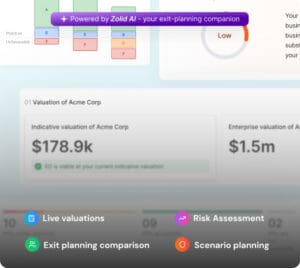 Advisors using Zolidar say it helps them:
- Bring EO into conversations earlier and more confidently
- Explore “what if” scenarios without overwhelming clients
- Collaborate transparently rather than disappearing into spreadsheets
- Reframe succession as a choice that can be controlled and planned for
A pathway—not a pitch
Together, EO Advantage and Zolidar create something advisors have been asking for: a learning-to-activation progression that fits naturally into succession planning work.
- Learn what EO is and when it fits
- Introduce it thoughtfully and responsibly
- Evaluate its financial and operational feasibility
- Support owners as they make informed decisions
No assumptions. No pressure. Just a more complete advisory toolkit.
Why this moment matters
EO has been around for decades. What’s new is the growing recognition that it shouldn’t be considered a last-resort or “alternative” pathway. It should be part of every informed succession planning conversation.
Whether an owner ultimately chooses EO, the point is that they deserve to know it exists, and advisors are the ones who can make that possible.
Sam Brownell, a financial advisor, put it this way, “The trends are clear: fewer business owners are selling to their families. And many business owners I speak with are not confident that they have one or two key employees who could handle a buyout. However, if an advisor knows about EO exit options, they can solve multiple issues for an aging owner, including legacy, market value payment, operational continuity, and long-term wealth building for their employees and community.”
For advisors who want to explore further
- Build EO fluency: Start with ExitPro 101 or role-specific gateway courses.
- Strengthen your advisory practice: Pursue the Certified EO Advisor (CEOA) designation.
- See the workflow in action: Watch a short Zolidar overview, test an interactive demo, or schedule a live session.