The EO Equals Summit: Five Questions Shaping the Future of Employee Ownership
- Dallas Shelby
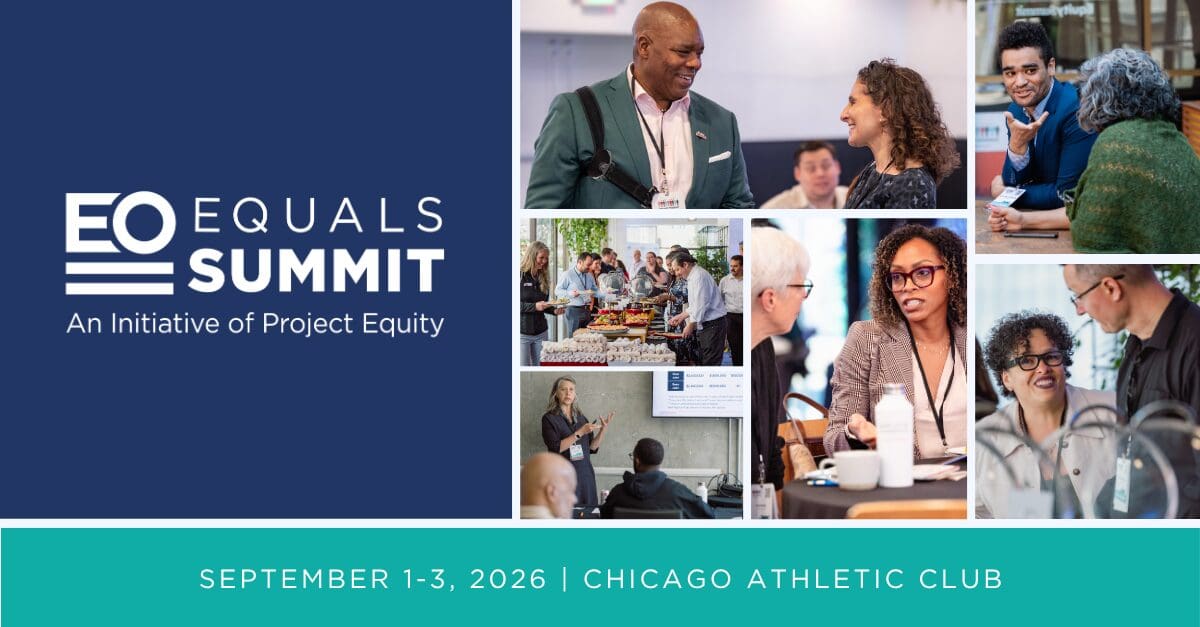
In a couple of weeks, people who influence the future of businesses and communities across the country will gather in Chicago for the EO Equals Summit.
They will come from business ownership and advisory, capital and philanthropy, government and economic development, higher education and technical assistance. Some have spent years helping businesses become employee-owned. Others are just beginning to explore what employee ownership could mean for the businesses and communities they serve.
What they have in common is an interest in what employee ownership can make possible and what might happen if more people knew how to use it.
These are the questions we’ll be addressing.
Why employee ownership and why now?
Employee ownership is gaining attention at a moment when business owners, workers, and communities are facing some significant challenges.
Thousands of business owners are approaching retirement and looking for ways to preserve what they’ve built. Workers are looking for greater economic security and a meaningful stake in the businesses where they work. Communities are looking for ways to build and retain wealth locally.
Employee ownership can connect those challenges to an opportunity: helping business owners secure their retirement while creating greater economic participation for the people who make those businesses successful.
The Summit will begin by asking why employee ownership matters now and what we stand to gain by making it a more visible and accessible option.
For business owners, that means seeing employee ownership as a powerful exit strategy and as a tool to preserve the future of a company they’ve built.
For advisors, it means recognizing when employee ownership might be the right succession strategy for a client.
And for advocates, funders, policymakers and other community leaders, it means understanding EO as a tool that can contribute to broader goals around wealth building, economic opportunity and resilient local businesses.
What can employee ownership change for a business and the people who work there?
The potential of employee ownership becomes most tangible at the level of an individual business.
At the Summit, we’ll hear directly from owners who chose to sell their businesses to their employees and from worker-owners who have experienced that transition. Their stories will help explore what changes when ownership changes hands – for the selling owner, the business and the people who work there.
The question is no longer whether employee ownership can work but what are the impacts of employee ownership when it becomes a real option for more businesses and their employees?
What can happen when employee ownership becomes part of a community’s economic development toolkit?
An employee-owned business doesn’t operate in isolation. Its ownership structure can have implications for the workers it employs, the wealth it creates and where that wealth stays. That’s why the Summit will explore what happens when communities and regions intentionally incorporate employee ownership into their economic development strategies.
We’ll hear from people working to unlock the power of EO across the country, as well as from funders and organizations using their economic influence to support small businesses, workforce development and community wealth.
For advocates and public-sector leaders, that means considering where EO fits alongside the other tools they already use to strengthen local economies.
For funders and capital providers, it means considering how investment and financing can help more businesses pursue employee ownership.
For business advisors and technical assistance providers, it means understanding how their work with individual companies can connect to broader community strategies.
What would it take to make employee ownership easier to recognize, access, and act on?
For employee ownership to reach more businesses, more people need to know what it is and know what to do with that knowledge.
That’s why the Summit will look at the practical infrastructure that can help EO grow: awareness and education, new ownership structures, innovative approaches to capital, and the advisors and technical assistance providers who help business owners navigate a transition.
This is where the different perspectives in the room become especially important.
A business owner doesn’t need to become an employee ownership expert. They need to know that EO exists, understand enough to recognize whether it might fit their goals and be able to find the right people to help them explore it.
An advisor doesn’t necessarily need to specialize in EO. They need to know when it belongs in the conversation and how to help a client take the next step.
And advocates, funders, policymakers, higher education institutions and other ecosystem builders can help create the awareness, knowledge, capital and infrastructure that make those conversations possible.
What could happen if we pulled all of those levers together?
The final question is about scale.
The Summit will explore how public policy can expand access to awareness, technical assistance, and capital; how higher education can incorporate employee ownership into curriculum, research and engagement; how capital can support transitions; and how regional ecosystems can bring these pieces together.
No single organization can create that kind of scale.
But a business advisor who knows when to raise the possibility of employee ownership, a funder who understands how to support it, a policymaker who creates the conditions for more transitions, a university that prepares future advisors to understand it, a technical assistance provider who can help a business owner take the next step, and a community leader who sees EO as part of a broader economic development strategy – each can move the possibility a little further. Together, they can begin to change what is considered possible.
That’s ultimately what we’ll be exploring in Chicago.
The EO Equals Summit isn’t about convincing everyone in the room that there is one right way to advance employee ownership. It’s about bringing together people with different levels of experience, different roles and different levers of influence to learn from one another and explore how EO can become part of the work they already do.
What’s next?
The EO Equals Summit is a closed-door, invitation-only gathering, but we’re always looking to bring new perspectives into the room. Learn more about the Summit →
After the Summit, EO Equals will share a report capturing what we heard, the ideas, insights, and possibilities that emerged as business owners, advisors, advocates, funders, capital providers, policymakers, public-sector leaders, higher education institutions and technical assistance providers came together to consider what employee ownership could make possible. Sign up to receive the EO Equals Summit report when it’s ready →
About the author
Dallas is an experienced nonprofit leader passionate about leveraging his talents to bring about real change. At Project Equity, he leads the communications and marketing team, helping to shape the narrative of employee ownership through storytelling and media engagement strategies.